

Your customers are still using keywords. But increasingly, they're describing problems.
Search is getting more conversational, and the long, specific questions people ask now reveal far more about who they are and what they need than a two-word keyword ever could. Here's why keyword research isn't dead, but it is incomplete, and where to actually find the language your customers use.



For years, search strategy has been built around keywords. Identify the phrases people use, assess their search volume and create pages or campaigns targeting the most commercially relevant terms.
That still matters, but it no longer tells the whole story.
As AI-powered search becomes more widely used, people are no longer required to translate a complicated need into two or three neat words. They can describe their situation, include specific requirements and continue the search through a series of follow-up questions.
Instead of searching for “CRM software”, someone might ask:
What CRM would suit a 20-person professional services business that needs automated lead follow-up, integrates with Xero and is simple enough for a small sales team to manage?
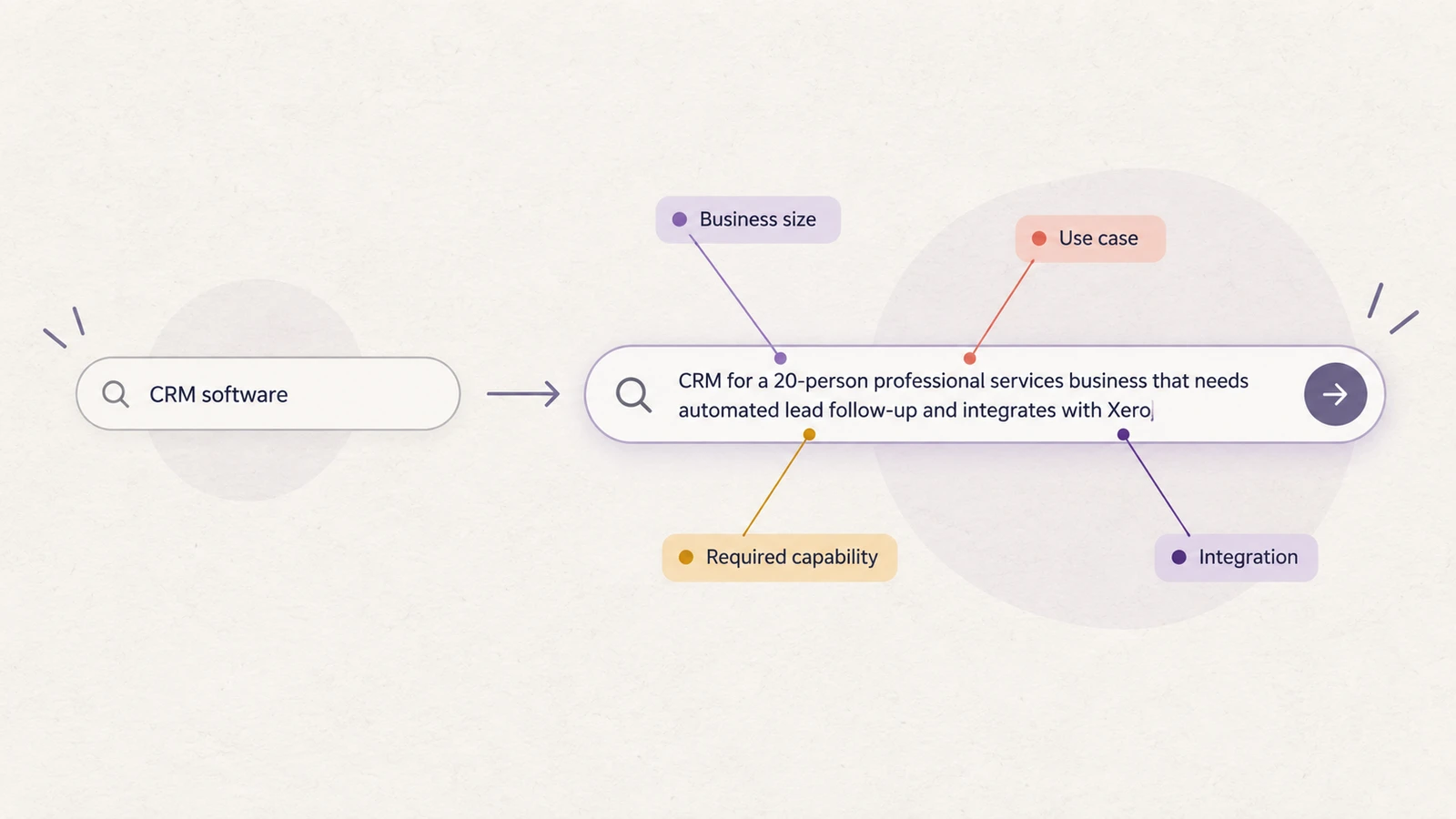
That search tells us far more than the original keyword. It reveals the size and type of business, the problem they are trying to solve, the features they consider important and one of the barriers likely to influence their decision.
The keyword identifies the category. The longer query describes the customer.
Search is becoming more conversational
Google is actively redesigning Search around more detailed and conversational behaviour.
In its announcement about thenew era of AI-powered Search, Google acknowledged that people’s curiosity does not always fit neatly into keywords. Its new AI search box expands to give people more room to describe what they need, offers suggestions that go beyond traditional autocomplete and allows them to ask follow-up questions without losing the context of the original search.
That changes the experience considerably. A person can begin with a broad problem, refine the criteria as they learn and move between research, comparison and action within the same conversation.
Google says AI Mode has surpassed one billion monthly users and that queries have more than doubled each quarter since its launch. It has also reported that overall search activity has continued to grow as people discover they can ask more complex and specific questions.
This does not mean people have stopped using short searches. Someone who already understands the category may still search for a product name, service or location. Others will continue to use search in much the same way they always have.
What is changing is the range of questions people can reasonably ask. Search is becoming better at handling the language people naturally use when they explain a problem rather than forcing them to reduce that problem to a keyword.
Longer searches can be more commercially revealing
A longer search is not automatically more valuable. People can ask detailed questions with no intention of buying anything. However, specificity often reveals commercial information that a short keyword cannot.
Compare these two searches:
Marketing agency Sydney
and:
Marketing agency for a growing Australian business that already uses several freelancers but needs someone to own the overall strategy
The first query tells us that someone is looking for a marketing agency in a particular location. The second tells us what the current operating model looks like, why it is no longer working and what the business expects from the alternative.
That distinction matters because search volume and commercial value are not the same thing.
A broad phrase may generate thousands of searches while bringing together people with very different needs and levels of intent. A detailed question may have little measurable search volume but describe exactly the type of customer a business wants to attract.
Traditional keyword research often encourages marketers to prioritise volume because it is visible and easy to compare. Longer queries remind us to look at what sits behind the number.
What triggered the search? What has the person already tried? Which requirement matters most? What is preventing them from making a decision? How close are they to choosing a solution?
The answers to those questions are valuable well beyond SEO. They can influence advertising, website structure, product positioning, sales material and follow-up communication.
Keyword research is not dead, but it is incomplete
It would be premature to abandon keyword research. Keywords still provide useful information about how people categorise a problem, which products and services they recognise and where demand exists at scale.
The mistake is treating a keyword list as a complete representation of the customer.
Search-volume tools tend to organise demand into convenient categories. That makes the information easier to plan around, but it can remove the context that gives the search commercial meaning.
A business might see strong volume for “business automation” and decide to create a comprehensive page targeting the term. Yet the people behind those searches may be trying to automate completely different processes. One may be struggling with lead follow-up, another with invoice management and another with customer onboarding.
A generic page explaining the benefits of automation may technically address the keyword while failing to answer any of those specific problems particularly well.
Understanding the broader search language allows the business to move beyond a category page and create information around genuine use cases, constraints, objections and decision criteria.
That does not mean creating a separate article for every slightly different search phrase. It means understanding the recurring themes within those searches and developing content that answers the underlying need properly.
SEO, AEO, paid search and website content are converging
Customers do not separate their research journey into SEO, AEO, paid search and content marketing. They ask a question and use whichever source appears most useful.
The answer may come from an organic result, an AI Overview, a paid advertisement, a YouTube video, a Reddit thread, ChatGPT or a company’s website. The person may move between several of those sources before making contact.
Businesses still need specialist knowledge across these channels, but the information supporting them should not be developed in isolation.
The questions uncovered through sales calls should influence website content. Paid-search terms should help identify organic content opportunities. Customer objections should inform FAQs and comparison pages. Strong website content should give search engines and AI platforms clearer information to interpret and reference.
This is where search strategy becomes less about building separate lists for separate channels and more about creating a connected understanding of customer demand.
The company that understands the customer’s language can use it across search, advertising, content, sales and automation. The company relying only on a keyword spreadsheet is working with a much narrower view.
So how do you discover what customers are really asking?
The challenge is that no single platform will provide a complete record of every question customers ask. The useful information is scattered across search data, advertising platforms, website behaviour, sales conversations and customer service interactions.
The goal is not simply to collect a larger list of phrases. It is to identify patterns in the way customers describe their situations, what they care about and what prevents them from acting.
There are several useful places to start.
Look beyond the top queries in Search Console
Google Search Console shows the queries that generated impressions or clicks for a website. Most businesses naturally focus on the highest-volume terms, but some of the more commercially revealing information can appear further down the report.
Look for complete questions and searches containing qualifiers such as “for”, “with”, “without”, “cost”, “versus” or “best for”. These additional words often provide clues about the use case, audience or buying criteria.
The individual numbers may be small, but repeated patterns across multiple searches can reveal a meaningful content opportunity.
Google has also introduced dedicatedgenerative AI performance reporting in Search Console. These reports show which pages have appeared in AI Overviews and AI Mode, along with impressions, countries, devices and visibility over time.
There is an important limitation: the generative AI report does not currently reveal the exact prompts behind those appearances. It can show that a page is gaining visibility within AI-powered results, but not every question that caused it to appear.
Businesses therefore need to combine this data with other sources rather than expecting Search Console to reveal the whole journey.
Review paid-search terms alongside lead quality
Google Ads search-term data can show the searches that triggered an advertisement, although not every query is disclosed.
This becomes far more useful when the data is connected to CRM outcomes. Instead of looking only at which terms generated clicks or leads, businesses can examine which types of searches produced qualified opportunities and customers.
Perhaps broad category searches generate a large number of inexpensive leads, while more detailed searches produce fewer enquiries but a much higher proportion of genuine buyers.
Without the CRM connection, the broad keywords may appear to be performing better. With revenue and lead-quality data included, the conclusion could be very different.
Examine what people search for on your website
If a website has an internal search function, its data can reveal what visitors expected to find but could not locate easily.
These searches may highlight missing content, unclear navigation, confusing terminology or information that deserves greater prominence.
Chatbot and live-chat conversations can provide similar insight. Pay attention to questions that appear repeatedly, particularly those asked immediately before someone requests a price, books a demonstration or asks to speak with a person.
The important language may not always look like a search query. It might appear as a frustrated explanation, a comparison question or a concern about whether the product will work in a particular situation.
Listen to sales calls
Some of the most valuable search insight never appears inside a search tool.
Sales calls capture how customers describe a problem before they have learned the terminology used by the industry. They reveal what happened inside the business, why the issue has become urgent and which concerns are shaping the decision.
Reviewing call transcripts, meeting notes and CRM records can help answer questions such as:
- What caused the customer to start looking now?
- How did they describe the problem in their own words?
- What had they already tried?
- Which alternatives were they considering?
- What were they worried would go wrong?
- What prevented previous opportunities from progressing?
This is not only useful for generating article ideas. It can reveal where a company’s website uses language that is technically correct but disconnected from the way customers actually speak.
Use customer service data too
Search insight should not stop when the sale closes.
Support tickets, customer emails and onboarding questions reveal where expectations and understanding break down after purchase. These conversations can uncover missing information, misunderstood features and areas of perceived risk.
Some of those questions may also be influencing prospects before they make a decision. Addressing them clearly can improve both discoverability and conversion.
Customer service data can be particularly useful for developing implementation guides, comparison pages, FAQs and content explaining what customers should expect after choosing a solution.
Use public search behaviour as a supporting source
Google autocomplete, People Also Ask, Google Trends, Reddit, industry forums and social comments can help identify how a subject is being discussed publicly.
They are useful for finding language, emerging concerns and questions that may not yet appear prominently in keyword tools.
However, a question appearing online does not automatically make it relevant to your business. Public data becomes far more useful when the same theme also appears in your search reports, sales calls, CRM or customer conversations.
The strongest insights are often found where several sources overlap.
Customer language should influence more than content
Once a business understands how customers describe their problems, the information should not be confined to the content calendar.
It can influence homepage messaging, service-page structure, paid advertising, sales scripts, lead-nurture emails and product positioning. It can also help a business recognise when its internal language is getting in the way of customer understanding.
Companies naturally develop shorthand for their services, products and processes. Customers may use completely different words because they understand the problem but do not yet know the category or solution.
If marketing uses only the language of the business, it risks missing the people who are still trying to explain what is wrong.
Search insight therefore becomes more valuable when it is treated as customer insight rather than simply SEO data.
Search is revealing more of the problem behind the query
The future of search is not keywordless. Keywords will continue to matter because they help search engines and businesses understand demand at scale.
But as search becomes more conversational, the businesses with the clearest understanding of their customers will have an advantage. They will not only know which terms people search. They will understand the problems, constraints and decisions behind them.
That understanding will not come from one platform or report. It will come from connecting search behaviour with advertising data, website activity, sales conversations, CRM outcomes and customer-service insight.
Your next content opportunity may not be sitting at the top of a keyword spreadsheet.
It may already be hiding in your last sales call.